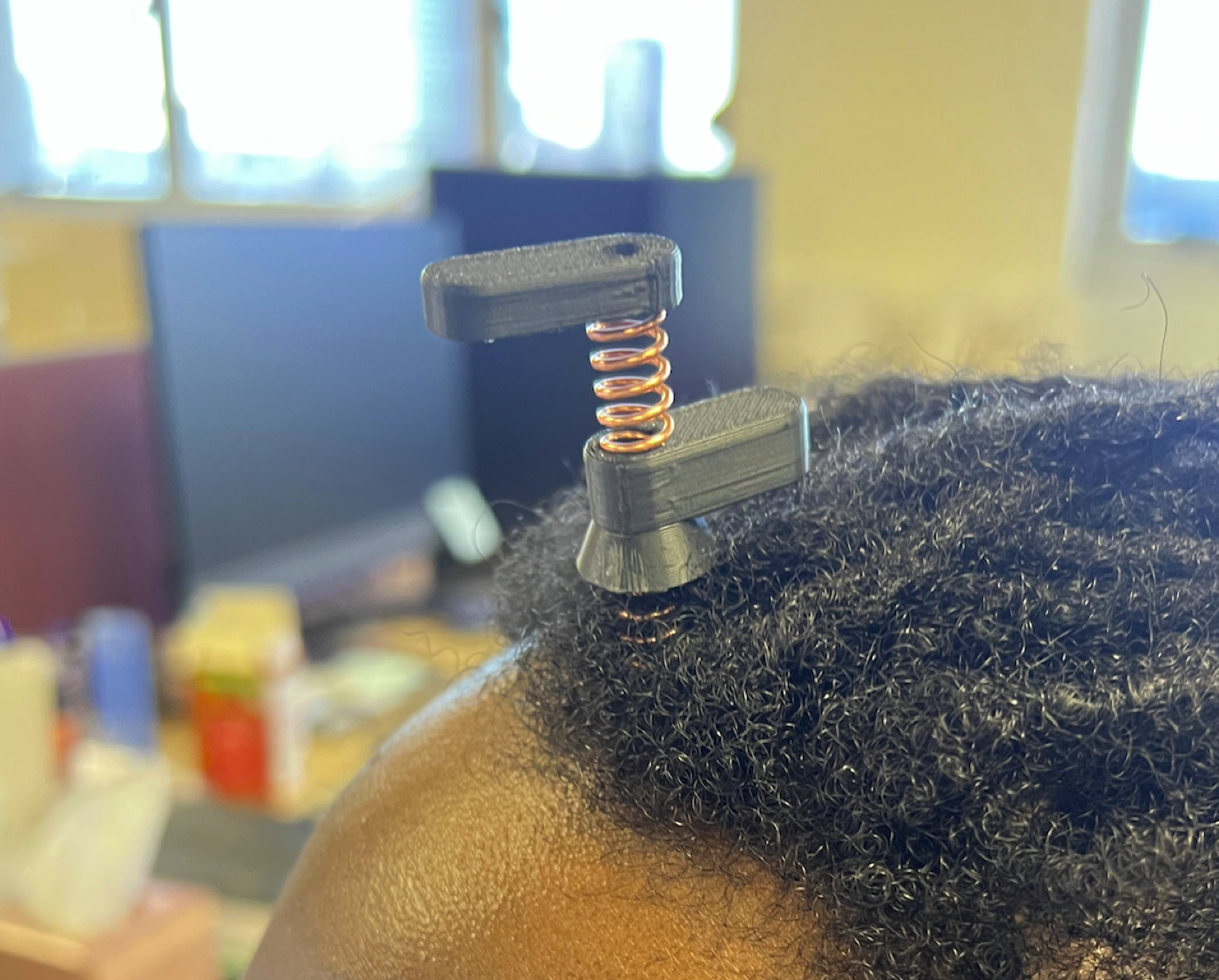
Existing solutions, including pin-based and braided-anchor electrodes, are real progress, but none reach the full target: reliable scalp contact, wet-electrode impedance, no hair modification, and minimal setup, for every hair type. Synaptive is built to meet all of it.
The electrode sits in a standard cap position and connects to your existing amplifier. What changes is how it makes contact: a compliant mechanism that parts and reaches through dense, curly and coily hair to meet the scalp, without gel-heavy preparation or braiding.
The design is novel enough that we have protected it. Our patent application is pending under number 2615593.7.
Our first patent filing is not limited to EEG. The same contact mechanism, reliable, comfortable contact through every hair type, applies directly to fNIRS, tDCS and tACS, and our application is written to cover all four.
Where we are proving the mechanism first: passive, drop-in electrodes that reach the scalp for reliable signal recording.
Functional near-infrared spectroscopy has the identical scalp-contact problem. The same mechanism applies to optical sensors.
Transcranial direct current stimulation depends on stable, low-impedance scalp contact to deliver current safely and consistently.
Transcranial alternating current stimulation carries the same requirement, and the same barrier for textured hair.
Health inequality in neurotechnology is not specific to one modality. Today we are focused on EEG, where the evidence and the need are clearest. The same patent-pending mechanism gives us a protected path to bring inclusive contact to every brain modality that depends on the scalp, not just the one we start with.
Others meet one or two of these. The target that matters is all of them at once, for every hair type.
Reliable scalp contact across straight, wavy, curly, coily and afro-textured hair, with no preparation or modification.
Signal quality at impedance levels equivalent to current clinical-grade wet electrode systems.
No extended preparation, no additional gel protocol, and no specialist knowledge required for diverse hair types.
Built to the requirements of academic research, clinical EEG and consumer BCI applications.

It shares the familiar form factor of the cup and disc electrodes you use today and connects straight to your existing amplifier over a standard connector. There is no new protocol to learn and no workflow to change, so adopting it is a swap, not a project.
The electrodes are reusable and research-grade, and they work for every participant, so you stop planning your studies around who the hardware can record from.
Bench recordings comparing Synaptive directly against a standard clinical cup electrode, under the same test conditions.
Two bench tests recorded side by side on Synaptive and a clinical cup electrode. First, eyeblink and jaw clench artefacts, showing the signal morphology tracks closely between the two. Then an eyes-open, eyes-closed recording over the occipital region, confirming the expected alpha peak, a well-established EEG phenomenon, to verify genuine brain signal is being measured.
| Amplifier | g.tec hiamp, via g.tec HiSys |
|---|---|
| Control electrode | Clinical cup electrode |
| Reference | Ear lobe |
| Ground | AFz |
Our flagship design is the subject of our patent-pending filing, and it is what early-adopter labs are testing today.
A passive, drop-in electrode that reaches the scalp across every hair type, and the subject of our patent-pending filing.
Electrode 1 feeds an AI denoising layer that cleans the recorded signal in software, improving quality across all hair types without changing your workflow. It is covered by our patent, and as the models improve, your electrode improves with them.
| Connector | 1.5 mm DIN touchproof (DIN42802) |
|---|---|
| Amplifier compatibility | BrainProducts, g.tec, BioSemi, ANT Neuro and other standard 1.5 mm DIN systems |
| Hair types | Straight, wavy, curly, coily and afro-textured |
| Signal path | Conducted directly to your amplifier, no onboard electronics |
| Construction | Reusable, research-grade |
| Intellectual property | Patent-pending, number 2615593.7, covering EEG, fNIRS, tDCS and tACS |
| Regulatory status | Class I CE marking in progress. Not yet a certified medical device. |