Preliminary data · 11 September 2026

Don't take our word for it.

See how Syn-R1 holds up against the electrode you already use. We put it head to head with a g.tec Ladybird passive wet electrode on the same head, at the same time, through the same amplifier and the same reference.

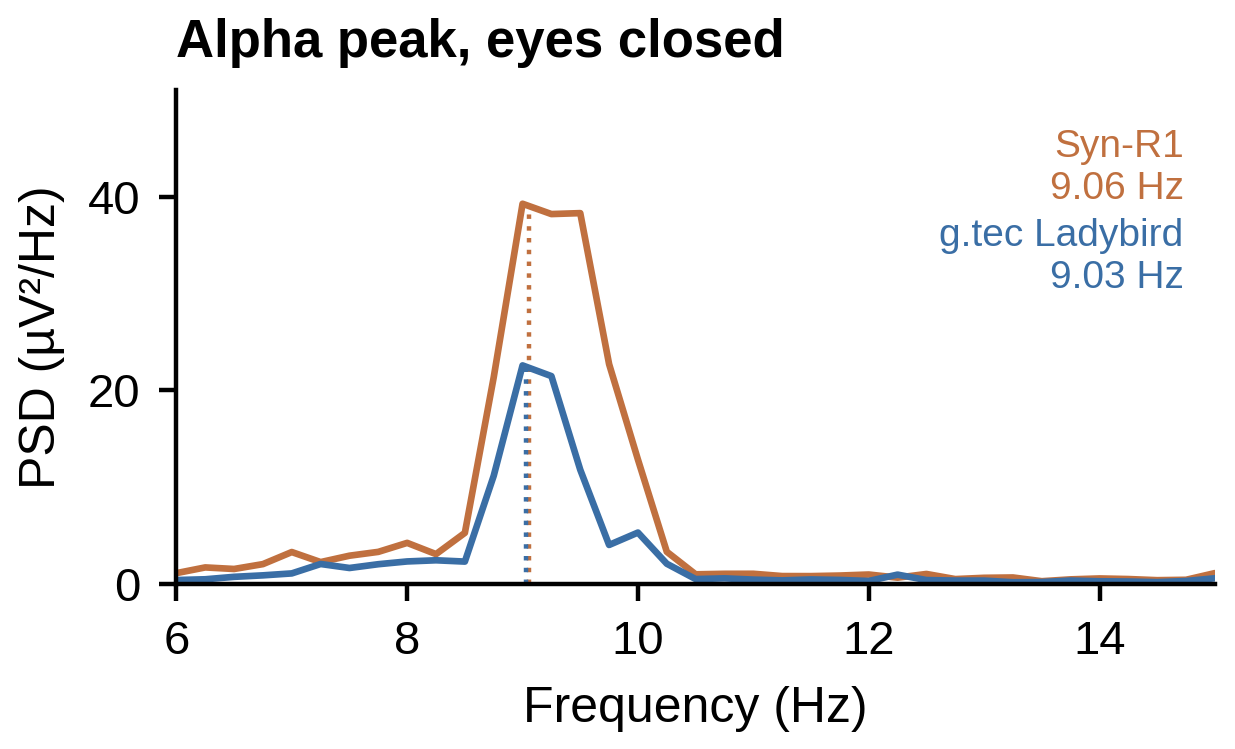
Power spectral density from 6 to 15 Hz for both electrodes with eyes closed. Syn-R1 peaks at 9.06 Hz and the g.tec Ladybird at 9.03 Hz, the two dotted markers sitting on top of each other.
Both electrodes found the same rhythm, at the same frequency. Occipital alpha with eyes closed. Syn-R1 peaks at 9.06 Hz, the Ladybird at 9.03 Hz. That is 0.03 Hz apart, closer together than one frequency bin. Alpha frequency is a property of the brain, not the sensor, so landing on the same number means both are reading the same neural source rather than similar-looking noise.
16.5 vs 16.0 dBHow far the peak stands above the 1/f background. A compromised electrode interface distorts this. Neither channel is distorted.
+9.3 vs +8.2 dBThe jump in alpha power on closing the eyes, the change the electrode exists to detect.
1.000 vs 0.992Odds of calling eyes open or closed correctly from a single two-second window of alpha power.
0.99Deming slope between the two channels. They track each other across the whole range, not just at one signal level.
The paper

Full methods, every measure, and the raw file.

Fourteen signal-quality measures across amplitude, spectral shape, noise and function. Agreement tested four ways rather than by correlation alone, and equivalence tested directly rather than inferred from a non-significant difference. The Ladybird wins three of the fourteen; those are in there too.

R. Patel, M. A. Kelly · UCL and Synaptive Ltd · 4 pages, PDF

Download the paper

Nothing is pre-processed or hand-trimmed: the analysis window comes from a fixed rule in the methods, not a chosen time range. Run it yourself and tell us if we got it wrong. We would rather hear it from you than from a reviewer. Get in touch.